
พรุ่งนี้ (จะไปกับเธอ) – โบ สุนิตา
Text-to-Speech (TTS) Analysis System with Client-Side Processing
In todays digital age, text-to-speech (TTS) technology has become a crucial tool for increasing accessibility and enhancing user experiences across platforms, from devices for the visually impaired to smart assistants. Developing this technology efficiently and quickly is essential. This article focuses on developing a text-to-speech analysis and synthesis system using client-side processing technology, an approach that enables TTS conversion to occur directly on a user’s web browser, thereby reducing server load and increasing response speed. The work covers everything from the process of TTS, user interface (UI) development, to Web Speech API implementation. Furthermore, to ensure the quality of the synthesized voices, a systematic evaluation was conducted using the internationally-standardized Mean Opinion Score (MOS) for Thai voices from Microsoft client-side TTS voices, namely Pattara and Kanya, to measure clarity, naturalness, and fluidity. The results of this project not only serve as a prototype for an effective TTS system, but also provide valuable insights for the future development of synthetic voices that are more natural and closely approximate human speech.
Taskeow Srisod, Prachyanun Nilsook, Sasitorn Issaro, Oraphan Amnuaysin, Thananan Areepong, Orawan Saeung, Thani Jintasuttisak and Thamasan Suwanroj.
Text-to-Speech (TTS) Analysis System with Client-Side Processing.
Journal of Theoretical and Applied Information Technology 15th April 2026. Vol.104. No.7
https://doi.org/10.5281/zenodo.19593882
Emerging trends in virtual simulation for education: A systematic review of technology– pedagogy alignment
Keywords:
Virtual Simulation, Educational Technologies, Instructional Design
Abstract
Virtual simulation has become a transformative approach in education, particularly in contexts that require practical, skill-oriented learning. This systematic review examines emerging trends in virtual simulation for education by synthesizing evidence on educational technologies and instructional design approaches applied in virtual laboratory environments. Guided by the PRISMA protocol and the PSALSAR framework, 20 peer-reviewed journal articles published between 2020 and 2024 were systematically selected and analyzed. The results indicate a growing emphasis on virtual laboratories and immersive technologies, especially virtual and augmented reality, to support hands-on learning across science, engineering, medical, and vocational education. These technologies are predominantly implemented through learner-centered instructional designs, including experiential, inquiry-based, and constructivist approaches, which facilitate active engagement, repeated practice, and meaningful knowledge construction. While immersive and simulation-based technologies dominate current implementations, the integration of AI-supported and analytics-driven systems remains limited, suggesting an emerging area for future development. This review contributes a synthesized conceptual framework that illustrates how virtual simulation technologies are pedagogically operationalized through instructional design themes to produce meaningful learning outcomes. By integrating technological and pedagogical perspectives, the findings provide a structured foundation to inform evidence-based instructional design, implementation, and future research on virtual simulation–based education.
Yindeemak, A., Pasmala, R., Chooppawa, P., Nammanee, M., Jantakoon, T., Wannapiroon, P., & Nilsook, P. (2026). Emerging trends in virtual simulation for education: A systematic review of technology–
pedagogy alignment. International Journal of Technology in Education and Science (IJTES), 10(2), 417-442.
https://doi.org/10.46328/ijtes.6779
Experiential Design Thinking Learning Model through Virtual Co-Working Spaces
Abstract—This study employed a research and development methodology with the objectives of developing an experiential design thinking learning model through virtual co-working spaces to enhance digital entrepreneurship competencies. The model integrates experiential learning concepts, design thinking processes, virtual co-working environments, and the digital entrepreneurship competency framework. The sample comprised 30 undergraduate students majoring in Business Information Technology. Data were analyzed using descriptive statistics. The findings reveal that the experiential design thinking learning model through virtual co-working spaces comprises two principal components: (1) a six stage experiential design thinking learning process encompassing User Understanding, Experience Creation, Reflection, Prototyping, Experimentation, and Real-World Integration; and (2) virtual co-working spaces incorporating seven dimensions: instructional management, technology infrastructure, collaboration mechanisms, support systems, security protocols, motivational elements, and assessment frameworks. The overall evaluation of the model indicated a high level of appropriateness (M = 4.59, SD = 0.50). Among the individual dimensions, data security achieved the highest mean score (M = 4.77, SD = 0.43), followed by learning process activities (M = 4.67, SD = 0.48). These results demonstrate that the model is highly appropriate and shows strong potential for application in enhancing digital entrepreneurship education within contemporary contexts.
Keywords—experiential learning, design thinking, virtual coworking space, digital entrepreneurship
Noppadol Saikatikorn, Panita Wannapiroon, and Prachyanun Nilsook, “Experiential Design Thinking Learning Model through Virtual Co-Working Spaces,” International Journal of Information and Education Technology, vol. 16, no. 3, pp. 708-717, 2026.
https://doi.org/10.18178/ijiet.2026.16.3.2543
Application of Gamified Hybrid Competency-Based Learning to Enhance Vocational Students’ Digital Safety Skills
Abstract—Digital safety skills are essential for vocational students as technology becomes a core component of almost every industry. Thus, students’ understanding of how to stay safe online and use digital tools responsibly is critical for their academic and future success. However, traditional learning methods cause students to lack motivation and not understand the risks associated with the digital world. Without a clear understanding of these risks, learning about digital safety becomes less of a priority. This study presents an application of Gamified Hybrid Competency-Based Learning (GH-CBL). We designed and developed a GH-CBL system to enhance digital safety skills among vocational students. Experts validated the system design to ensure the appropriateness of its components for educational implementation. A pre-experimental research design was employed with a one-group pretest-posttest method with a sample of 40 vocational students. The research findings revealed that experts consider GH-CBL suitable for vocational students’ learning. In addition, the students’ digital safety achievement scores increased significantly before and after learning.
Keywords—vocational education, competency-based learning, gamification, digital platform, digital safety
Nutthacha Siengdee, Sasithorn Chookaew, and Prachyanun Nilsook, “Application of Gamified Hybrid Competency-Based Learning to Enhance Vocational Students’ Digital Safety Skills,” International Journal of Information and Education Technology, vol. 16, no. 2, pp. 569-573, 2026. https://doi.org/10.18178/ijiet.2026.16.2.2528
KMUTNB Researchers
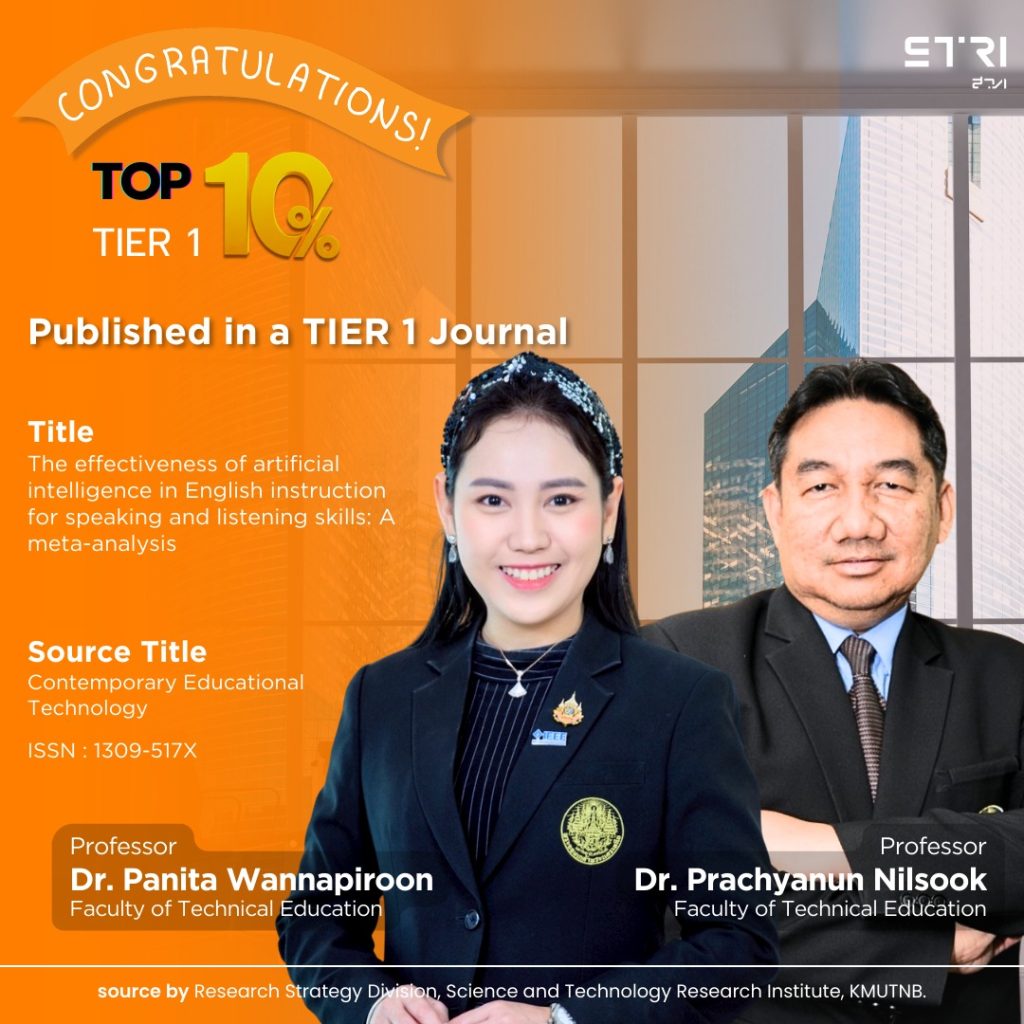
🎉🔶✨Congratulations’ 🎉🔶✨
👨💼 KMUTNB Researchers
Published in a TIER 1 Journal📊
.
Top 10% or Tier 1 in 2025
🔶Professor Dr. Panita Wannapiroon
🔶Professor Dr. Prachyanun Nilsook
🏢(Faculty of Technical Education)
📖Title : The effectiveness of artificial intelligence in English instruction for speaking and listening skills:
A meta-analysis
.
source by Research Strategy Division, Science and Technology Research Institute, KMUTNB.
https://doi.org/10.30935/cedtech/17310
ICTAECT2025 IEEE
ผลงานวิจัยในการประชุมวิชาการระดับนานาชาติ
2025 5th International Conference on Educational Communications and Technology (ICTAECT)
https://ieeexplore.ieee.org/search/searchresult.jsp?newsearch=true&queryText=ICTAECT
W. Srisung, P. Piriyasurawong and P. Nilsook, “Skill-A-Thon Action Learning Framework,” 2025 5th International Conference on Educational Communications and Technology (ICTAECT), Bangkok, Thailand, 2025, pp. 1-5, https://doi.org/10.1109/ICTAECT67351.2025.11391285
C. Chawarangkoon, P. Wannapiroon and P. Nilsook, “Learning Platform Based on Spatial Computing,” 2025 5th International Conference on Educational Communications and Technology (ICTAECT), Bangkok, Thailand, 2025, pp. 1-5, https://doi.org/10.1109/ICTAECT67351.2025.11391262.
W. Milinthapunya, P. Nilsook and P. Wannapiroon, “Generative AI in Higher Education: A Student Perspective,” 2025 5th International Conference on Educational Communications and Technology (ICTAECT), Bangkok, Thailand, 2025, pp. 1-6, https://doi.org/10.1109/ICTAECT67351.2025.11391308.
N. Pramon, P. Wannapiroon and P. Nilsook, “Conceptual Framework of Artificial Intelligence Strategy with Scenario-Based Training,” 2025 5th International Conference on Educational Communications and Technology (ICTAECT), Bangkok, Thailand, 2025, pp. 1-8, https://doi.org/10.1109/ICTAECT67351.2025.11391299.
P. Yaiyindee, P. Wannapiroon and P. Nilsook, “AI-Enhanced Learning for Engineering Community of Practice,” 2025 5th International Conference on Educational Communications and Technology (ICTAECT), Bangkok, Thailand, 2025, pp. 1-8, https://doi.org/10.1109/ICTAECT67351.2025.11391267.
S. Channgam, W. Jarunopratam, E. Gedkhaw, N. Soodtoetong and P. Nilsook, “Developing Virtual Reality-Based Tourism to Promote Historical and Community Culture in Chainat, Thailand,” 2025 5th International Conference on Educational Communications and Technology (ICTAECT), Bangkok, Thailand, 2025, pp. 1-6, https://doi.org/10.1109/ICTAECT67351.2025.11391255.
M. Warasart, P. Piriyasurawong, P. Wannapiroon and P. Nilsook, “Gamified Social Collaboration via Mesh CoP: Effectiveness in Enhancing Cybersecurity Awareness,” 2025 5th International Conference on Educational Communications and Technology (ICTAECT), Bangkok, Thailand, 2025, pp. 1-6,
https://doi.org/10.1109/ICTAECT67351.2025.11391320.
Intelligent (LLM) Knowledge Management System with Asynchronous Technology and Text-to-Speech Using PHP Language
Abstract
This paper introduces a sophisticated knowledge management system developed to address the growing demand for real-time information retrieval and interaction. The system architecture leverages a robust Hypertext Preprocessor (PHP) backend to integrate Google’s Gemini Application Programming Interface (API) for advanced Large Language Model (LLM) functionalities, such as complex querying and content summarization. A key innovation is the implementation of PHP Fibers to manage I/O-bound tasks asynchronously, effectively overcoming the limitations of conventional synchronous processing and preventing application bottlenecks. For data retrieval, the system utilizes SQLite’s FTS5 extension for high-speed, indexed full-text search across large local datasets. To enhance accessibility, the Web Speech API is incorporated for text-to-speech functionality. Quantitative performance evaluation reveals that this asynchronous architecture achieves an improvement of up to 87% terms of information retrieval speed and reduces the average response latency by 35% compared to synchronous counterparts. Furthermore, the text-to-speech feature not only promotes inclusivity for users with disabilities but also facilitates more efficient cognitive processing of large volumes of information. © 2026 by the authors.
Author keywords
asynchronous programming; Hypertext Preprocessor (PHP) language; knowledge management system; Large Language Model (LLM); text-to-speech
Pinyaphat Tasatanattakool, Taskeow Srisod, Prachyanun Nilsook, Panita Wannapiroon, and Jira Jitsupa, “Intelligent (LLM) Knowledge Management System with Asynchronous Technology and Text-to-Speech Using PHP Language,” Journal of Advances in Information Technology, Vol. 17, No. 2, pp. 340-351, 2026.
https://doi.org/10.12720/jait.17.2.340-351
AI-Based Model with Intelligent Production Stages for Educational Video Creation
Abstract
This research aims 1) to develop an AI-based model with an intelligent production process for educational video creation 2) to synthesize key learner characteristics related to developing creative confidence and 3) to validate the developed conceptual model through expert evaluation. The instrument used is a conceptual model designed by the researchers to support the production of intelligent educational videos and promote learner creative confidence. The model integrates AI technologies such as Natural Language Processing (NLP), computer vision, neural Text-to-Speech (TTS), and machine learning across 4 intelligent production stages: scriptwriting, storyboarding and visualization, voiceover recording, video editing and assembly. Each stage was aligned with traditional media production tasks to enhance instructional relevance and workflow efficiency. In parallel, the researchers conducted a synthesis of learner characteristics related to creative confidence, resulting in 5 domains: intellectual, creative mindsets, creative action, motivational drivers, and reflective awareness. These traits were structured into a pedagogical framework and further operationalized into analytic criteria to inform the design and assessment of learner-centered activities in AI-enhanced educational environments. The results show that the model not only makes AI-based media production more efficient, but also provides a solid foundation for cultivating creativity in digital education systems. This research contributes to the growth of AI in education by identifying creative confidence as a key learner outcome. It also provides educators with validated models and relevant tools for integrating AI into instructional workflows, empowering learners to confidently create, reflect, and express in technology-rich learning contexts. © 2026 by the authors.
Author keywords
Artificial Intelligence (AI)-based content creation; artificial intelligence in education; creative confidence; educational video production; intelligent production stages
Naphatsanan Suwannawong, Phatchareephorn Bangkheow, Prachyanun Nilsook, Panita Wannapiroon, Siwaporn Linthaluek, and Jidapha Yoorubsuk, “AI-Based Model with Intelligent Production Stages for Educational Video Creation,” International Journal of Information and Education Technology, vol. 16, no. 1, pp. 164-173, 2026. https://doi.org/10.18178/ijiet.2026.16.1.2491